What if every factory had the right neighbours?
Malta's industrial estates mix clean and heavy industry side by side. A national plan could sort them into zones, moving firms as their leases end.
Watch the idea in 2 minutes
The problem
Malta’s government industrial estates are run by INDIS Malta, a state company. It manages 16 estates covering about 3 million square metres, home to around 900 operators.[1] Space is so tight that in 2020, the industrial space available could meet only 4% of the demand from projects approved or being considered by Malta Enterprise.[1]
When space is that scarce, it is hard to keep very different kinds of work apart. The public record shows what can happen when they end up side by side:
- Food next to cement. By 2013, a cement silo was operating at Corradino less than 10 metres from the Kordin grain terminal’s silo. The planning authority decided it did not need planning permission. A risk assessment commissioned by the cement operators themselves concluded that “the possibility that the grain being handled nearby will be subject to a level of contamination from cement dust remains present even following the application of best practices.”[2]
- A fire next door. In May 2016, a detergent factory in Bulebel caught fire, and workers in the adjoining factories had to be evacuated.[3]
- Fumes over whole towns. In April 2011, a fire at a factory making cleaning products in Imriehel led Civil Protection to tell residents of Imriehel, Ħamrun, Santa Venera, Qormi and Balzan to keep their windows shut, warning that “the fumes might be toxic”.[4]
Malta is investing heavily in its estates. The government’s €470 million programme, launched in 2020, aims to create new space by reorganising existing zones, building upwards and accommodating “organized business clusters”.[5][1] But as reported, the programme does not say which kinds of industry should sit together, and which should be kept apart.[1]
New land is coming, and it is contested
The government plans to reclaim land outside the Freeport perimeter, mainly for industry, and has said it wants to relocate commercial activity from other areas.[6] In October 2026 it also tendered a feasibility study for a 100,000 square metre industrial zone on the Bengħajsa shoal. Nine groups, including fishers’ associations, BirdLife Malta and Nature Trust, oppose it, warning of harm to small-scale fishers, to protected seagrass meadows and to two Natura 2000 sites, and saying the local community was not consulted.[7]
On land, the edges of the estates are contested too. In 2026 the government decided to take farmland at Bulebel out of the industrial zone and designate it outside the development zone, after farmers, the NGO Wirt iż-Żejtun and the local council campaigned to protect it.[8]
This proposal takes no side on reclamation. That decision needs its own environmental assessment and real consultation. The point is narrower: whether or not new land is made, Malta needs a plan for who goes where.
The proposal
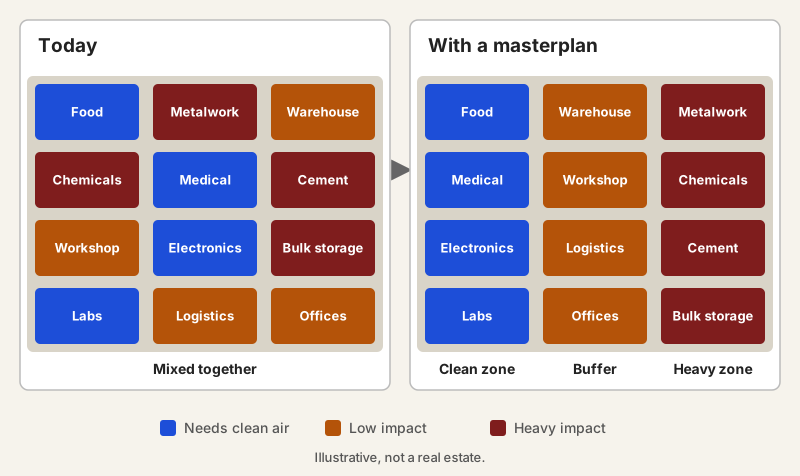
Draw up a national masterplan for industrial estates that sorts them into clean and heavy zones, and use it every time a plot changes hands.
Specifically:
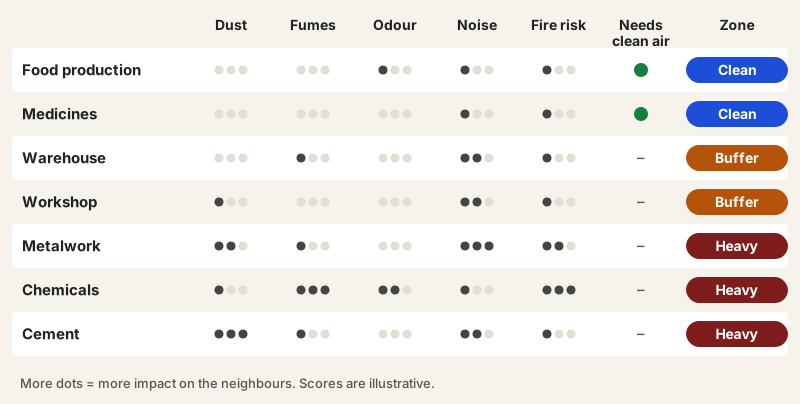
- Classify industrial activities by their impact: dust, fumes, odour, noise, and fire or chemical risk. The Netherlands already does this to decide which activities fit where on its industrial estates.[10]
- Designate zones. Clean zones for food, medical and pharmaceutical products, and electronics. Heavy zones for metalwork, chemicals, cement and bulk storage. Light, low-impact uses such as warehouses and workshops can act as a buffer between the two.
- Apply it now to every new allocation, so the problem stops growing from today.
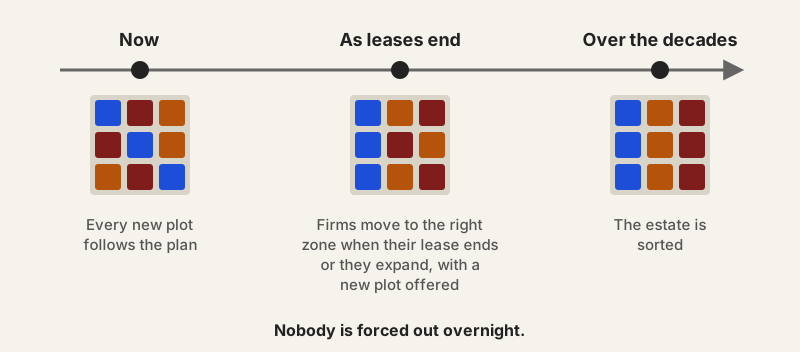
- Move existing firms when their lease or concession comes up for renewal, or when they apply to expand, and offer them a suitable plot in the right zone. Concessions on industrial land can run for decades, such as a 65-year temporary emphyteusis endorsed by INDIS in 2018.[9] That is exactly why the plan has to start now.
- Give heavy, higher-risk industries first call on any new industrial land, whether freed up in existing estates or created elsewhere, so they can move away from food producers and from homes.
- Publish the plan, so every business knows where it can grow.
INDIS Malta would lead, with the Planning Authority, the Environment and Resources Authority and the Occupational Health and Safety Authority.
What it can and cannot do
This will not move a single factory overnight, and it should not. Most firms would move only when their concession ends or when they grow, so the full effect would take decades. What it does immediately is stop new mismatches: no more cement silos beside grain silos because a plot happened to be free.[2]
Benefits
- Safer food and medicines. Keeping food and medical producers away from dust and fumes protects public health and the reputation of Maltese exports.[2]
- Fewer people at risk when something goes wrong. A fire or chemical leak in a heavy zone affects fewer, better-prepared neighbours.[3][4]
- Certainty for investors. A business that knows where it can expand, and who its neighbours will be, can plan and invest with confidence.
- Clusters that work. Similar firms side by side can share suppliers, services and skills. The government’s own plan already aims for organised business clusters; this gives them a map.[5]
- Better use of scarce land. With space this short, every square metre should go to a use that suits its neighbours, rather than one that will cause problems later.[1]
- Less pressure on farmland. Using existing estates better reduces the case for expanding into fields, as nearly happened at Bulebel.[8]
Cost and feasibility
The masterplan itself is a planning exercise, not a building project. It fits inside the reorganisation of the estates that the €470 million programme is already paying for.[5]
The real cost is moving firms. Tying moves to lease renewals and expansions keeps that cost down, because firms would be moving or refitting at those moments anyway. A relocating firm would get a suitable plot in the right zone as part of the deal. Government could add help with moving costs for the firms whose move matters most for safety.
Likely objections
- “Businesses will be forced out.” No. New allocations follow the plan straight away, but existing firms move only when their lease is up or they ask to expand, and always with an alternative plot.
- “This is a back door for land reclamation.” No. The plan works with the land we already have. Whether to reclaim at the Freeport or Bengħajsa is a separate decision, and the concerns of fishers and environmental groups deserve a full hearing in that decision.[7]
- “Malta is too small for this.” Size is the reason to plan. When land is this scarce, mistakes last for generations.[1]
- “Heavy industry has to go somewhere.” It does. The point is to put it together, with what it needs, away from food producers and homes.
Examples elsewhere
- The Netherlands. Dutch municipalities use guidance from their national association to place activities on industrial estates according to their environmental impact, separating sensitive uses from polluting ones. An updated version was published in October 2024, replacing the widely used 2009 edition.[10]
- Singapore. Jurong Island, formed from seven smaller islands, was planned as a dedicated site for the chemicals industry. It now hosts more than 100 companies employing about 26,000 people.[11]
Sources
- Factory zones set to expand vertically in 'largest' investment in industrial infrastructure. MaltaToday. Published 5 November 2020, accessed 15 November 2026. ↩
- Rock buns anyone?. Times of Malta (A. Deidun), archived by the University of Malta. Published 1 June 2014, accessed 15 November 2026. ↩
- Fire breaks out at factory in Bulebel. MaltaToday. Published 24 May 2016, accessed 15 November 2026. ↩
- Fire at Imriehel factory, CPD warns to keep windows closed. MaltaToday. Published 12 April 2011, accessed 15 November 2026. ↩
- €470 million industrial infrastructure plan based on 'revamping existing zones, better planning'. The Malta Business Weekly. Published 12 July 2021, accessed 15 November 2026. ↩
- Budget 2026: Large-scale land reclamation project to begin outside Freeport perimeter. The Malta Independent. Published 27 October 2025, accessed 15 November 2026. ↩
- 'A death blow': Nine groups warn Bengħajsa reclamation threatens small-scale fishers. Newsbook. Published 31 October 2026, accessed 15 November 2026. ↩
- PA publishes strategic plan review for land in Żejtun after decision taken to remove it from industrial zone. BusinessNow. Published 12 June 2026, accessed 15 November 2026. ↩
- €17 million public industrial land given to property developer to sub-lease. The Shift. Published 7 July 2023, accessed 15 November 2026. ↩
- Nieuw: VNG-handreiking Activiteiten en milieuzonering. VNG, Association of Netherlands Municipalities. Published 17 October 2024, accessed 15 November 2026. ↩
- Jurong Island: The Chemical Island. SG101, Government of Singapore. Published 6 October 2025, accessed 15 November 2026. ↩
Support this idea
Anyone can show support once per browser, with no sign-up. The number counts expressions of support, not verified people.
Showing support needs JavaScript turned on.