What if new buildings breathed through the cool rock beneath them?
A few metres under Malta the rock stays mild all year. Pipes laid there while digging foundations could pre-cool summer air and pre-warm winter air.
Watch the idea in 2 minutes
The problem
Malta cools its homes with air conditioners, one room at a time. Space cooling now takes 15% of all the energy Maltese households use, the second-highest share in the European Union after Cyprus.[1] Every unit pulls hot outside air or recirculated indoor air through a small compressor, and every unit runs hardest in the same few heatwave afternoons.
That is when the grid struggles. In July 2026 electricity demand reached a record 741 MW, almost 12% above the previous record of 663 MW set in the 2023 heatwave.[2]
Yet under every building site lies a large store of mild temperature that nobody uses. About 20 metres down, Malta’s globigerina limestone stays at around 20°C all year round, through August heat and January cold alike.[3] Every new block of flats with a basement garage digs into that rock and then covers it up again.
The proposal
Lay a set of pipes in the ground under or beside a new building, while the foundations are being dug, and draw the building’s fresh air through them before it reaches the rooms.
In summer, hot outside air gives up heat to the cooler ground as it travels along the pipes, so it arrives cooler. In winter the same pipes work the other way: the ground is warmer than the January air, so the air arrives pre-warmed. This is called an earth-air heat exchanger, and it needs only a fan to move the air.
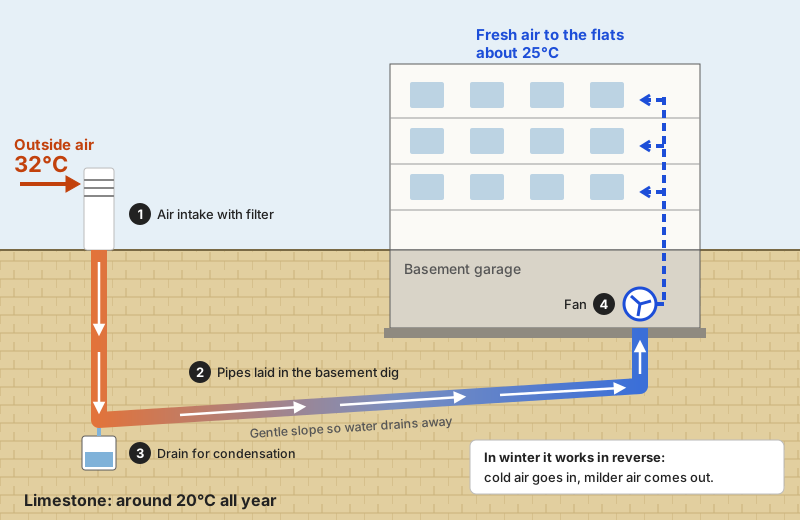
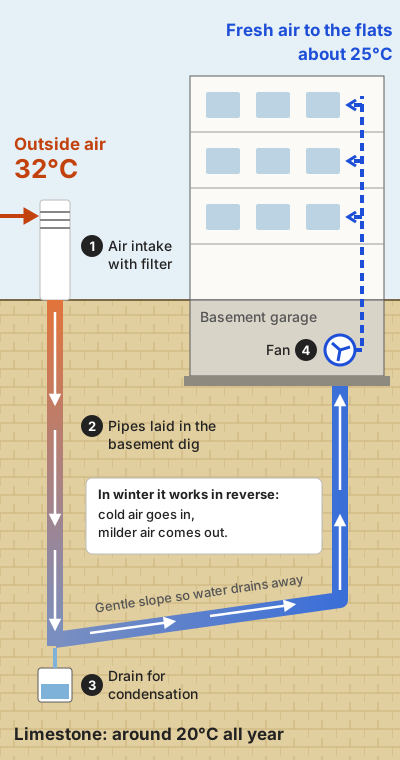
Specifically:
- The Building and Construction Authority should give earth-air pipes credit in Document F, the minimum energy performance rules that every new building must meet, which were last updated in July 2024.[10] At present a developer gains nothing on paper by fitting them.
- Government should fit them in a handful of new public buildings, such as schools or health centres, and publish the measured results, so that Maltese builders and architects can see real local figures.
- Developers who are already excavating basements should be encouraged to lay the pipes in the same dig, when the extra cost is at its lowest.
What it can and cannot do
This idea will not, on its own, replace air conditioning in a Maltese flat in August. Malta’s ground is warmer than the ground in northern Europe, where these systems are common, so the air leaving the pipes will be mild, in the mid-20s °C in hot climates, rather than cold.[3][4] The aim is to bring fresh air in already cooled, so that air conditioners are smaller, run for fewer hours and are not needed at all on many warm days in late spring and early autumn.
Benefits
- Lower peak demand. Pre-cooled air means each air conditioner works less during the heatwave afternoons that set Malta’s demand records.[2]
- Cheap to run. In a monitored system in southern Portugal, the pipes delivered about 330 kWh of cooling a day for about 50 kWh of fan electricity.[6]
- Comfort on mild days without any air conditioning. The same Portuguese system cooled an office room on its own whenever outside air was up to 33°C, and covered more than half the room’s cooling need at 37°C.[5]
- Winter warmth for free. Buildings draw air at close to ground temperature in winter, which is far milder than outside air on a cold, windy night.[3]
- Fresh air. New, airtight buildings need ventilation anyway. This supplies it pre-cooled or pre-warmed instead of letting in raw outside air.
Cost and feasibility
Where it fits best
The pipes are cheapest to lay when the ground is already open. In Malta that is common: many new apartment blocks dig one or more basement levels for garages. Laying pipes beneath the lowest slab, or in the excavated area around it, adds pipe, fittings and a fan, not a second excavation. Retrofitting existing buildings would cost far more and is not part of this proposal.
No Maltese cost figures exist yet, which is one reason a public pilot matters: it would give developers real local prices and real local performance before any rule asks more of them.
Condensation and hygiene
This is the main risk, and it has to be designed out. When warm, humid summer air cools inside the pipe, water can condense on the pipe walls. Researchers warn that stagnant condensate can encourage mould and bacteria.[7] The answer is good design: smooth pipes laid at a slope, with a drain at the low point so water never pools, plus filters and access for cleaning. A Swiss study of twelve working systems found bacteria and spore levels fell sharply along the pipes and that the air supplied indoors had far fewer microbes than outside air.[8] Any rule in Document F should therefore set design standards for slope, drainage and cleaning access.
Likely objections
- “Malta’s ground is too warm.” It is warmer than in Germany, but it is still much cooler than a summer afternoon and much warmer than a winter night.[3] Systems in Marrakech and southern Portugal, both places with hot summers, delivered useful cooling.[4][5]
- “There’s no space on Maltese plots.” Pipes can run under the building’s own basement slab, which every excavated site already has.
- “Developers won’t pay for it.” That is why the proposal starts with credit in Document F and a public pilot, not a mandate.
Examples elsewhere
- Marrakech, Morocco. Three 72-metre pipes buried 2 to 3 metres deep in the garden of a house supplied air at about 25°C throughout summer, while outside temperatures went above 40°C.[4]
- Southern Portugal. A large-diameter earth-air pipe cooled an office room through a hot, dry summer, with the air leaving the pipe up to 9°C cooler than the air outside.[5]
- Germany. Fraunhofer ISE monitored earth-air heat exchangers serving three office buildings in normal use and developed a standard method to compare how well they perform.[9]
Sources
- Energy use for cooling in EU households doubled in 6 years. Eurostat. Published 8 July 2026, accessed 14 November 2026. ↩
- Malta, record heat and electricity consumption soars. Italpress. Published 31 August 2026, accessed 14 November 2026. ↩
- Ground source heat pumps: potential applications & limitations in Malta (PLEA 2012, Lima). University of Malta (D. Borg, V. Buhagiar). Published 7 November 2012, accessed 14 November 2026. ↩
- Experimental and numerical study of an earth-to-air heat exchanger for buildings air refreshment in Marrakech. Energy and Buildings, vol. 125 (M. Khabbaz et al.). Published 1 August 2016, accessed 14 November 2026. ↩
- A Large-Diameter Earth-Air Heat Exchanger (EAHX) Built for Standalone Office Room Cooling: Monitoring Results for Hot and Dry Summer Conditions. Applied Sciences, vol. 13, no. 22 (Duarte, Gomes, Moret Rodrigues, Pimentel). Published 8 November 2023, accessed 14 November 2026. ↩
- Design and Performance of a Large-Diameter Earth-Air Heat Exchanger Used for Standalone Office-Room Cooling. Applied Sciences, vol. 15, no. 14 (MDPI). Published 1 July 2025, accessed 14 November 2026. ↩
- Heat transfer and condensation in an earth-air heat exchanger: 2D/3D numerical modeling validated by experimental measurements. Energy and Buildings, vol. 205 (G. Chardome, V. Feldheim). Published 15 December 2019, accessed 14 November 2026. ↩
- Microbial investigations and allergen measurements in ground-coupled earth-to-air heat exchangers. AIVC / Indoor Air 99 conference (B. Fluckiger, C. Monn, ETH Zurich). Published 9 August 1999, accessed 14 November 2026. ↩
- Evaluation of earth-to-air heat exchangers with a standardised method to calculate energy efficiency. Energy and Buildings, vol. 35, no. 10 (J. Pfafferott, Fraunhofer ISE). Published 1 November 2003, accessed 14 November 2026. ↩
- The Minimum Energy Performance Requirements in Buildings (Document F). Building and Construction Authority. Published 1 July 2024, accessed 14 November 2026. ↩
Support this idea
Anyone can show support once per browser, with no sign-up. The number counts expressions of support, not verified people.
Showing support needs JavaScript turned on.