Lockdown halved our traffic. What if we kept a little of it?
Traffic fell by half in the 2020 lockdown. A legal right to ask to work from home could keep part of that gain at rush hour, without forcing anyone.
Watch the idea in 2 minutes
The problem
Malta has more cars every week. At the end of September 2025 there were 454,138 licensed vehicles on the islands, and the fleet was growing by an average of 36 a day.[5] Most of them try to use the same roads at the same hours: the morning run to work and school, and the drive home.
That costs us. The government’s own National Transport Master Plan puts the cost of congestion at around €770 million in 2025, about 3.3% of Malta’s GDP, rising to €917 million by 2030.[2]
Yet many of the people sitting in that traffic do not need to be on the road at all. The Central Bank of Malta estimated that at least 15.5% of jobs in Malta can be done from home, and slightly more than 23% if less practical cases are included.[6]
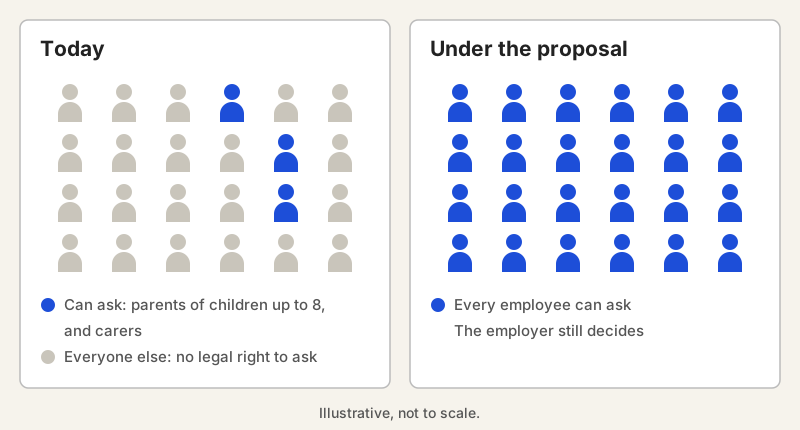
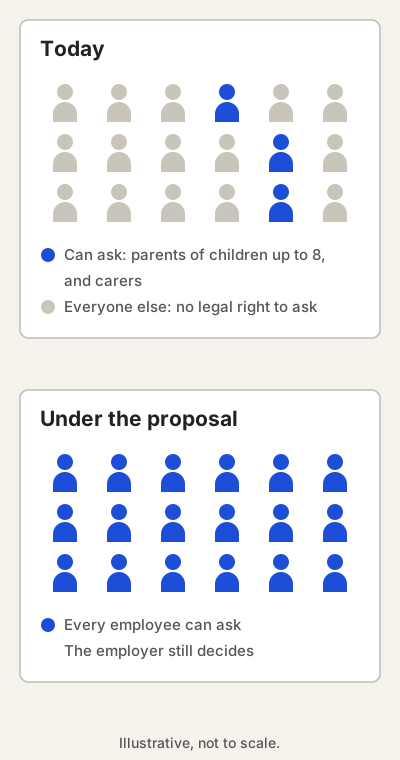
Most of those workers have no right even to ask. The law gives a right to request flexible working, including remote working, only to parents of children up to the age of eight and to carers. Their employer must reply within two weeks and give reasons for a refusal.[3] For everyone else, it depends entirely on the employer’s goodwill. The government consulted on wider remote-working rights in early 2026, but no reform had been enacted by March 2026.[7]
What lockdown showed, and what it did not
In April 2020, during the COVID-19 restrictions, University of Malta researchers found that traffic counts at Gudja and Blata l-Bajda were up to about 50% lower than in April 2019.[1]
Home working was only part of that. Schools, childcare centres and universities had closed on 12 March, and non-essential shops and services on 23 March.[1] So lockdown does not prove that working from home alone would halve our traffic, and this proposal does not claim it would.
What it did show is how quickly the roads clear when fewer cars set off at the same time. Of everything that changed in 2020, home working is the one part we can keep without closing a single school or shop. And Maltese workers have kept some of it: in 2023, 11.5% of employed people in Malta usually worked from home and another 13.9% sometimes did, both above the EU average.[8]
The proposal
Give every employee in Malta the legal right to request remote work, for some or all of their working days.
Specifically:
- Any employee can ask. Not just parents and carers, as today.[3]
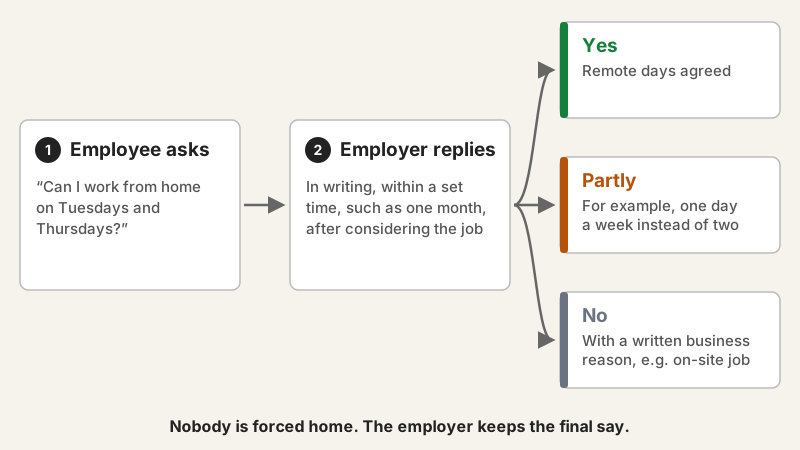
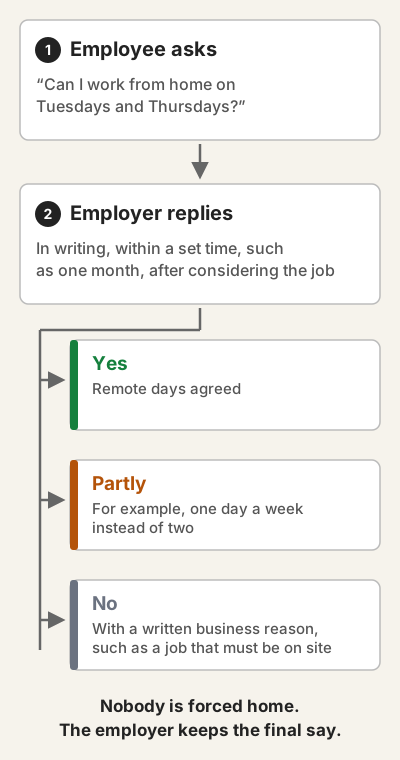
- The employer must answer properly. A reply in writing within a set time, such as one month. A refusal must give a real business reason, such as the job needing to be done on site, customer cover, or data security.
- A code of practice, agreed with unions and employers, explains how requests should be handled, as Ireland did when it introduced the same right.[12]
- Nobody is forced home. Jobs that cannot be done remotely are unaffected, and the employer keeps the final say.
- Measure the result. Transport Malta should publish peak-hour traffic counts before and after the change, so the effect on traffic is measured rather than assumed.
The idea is already on the table. Before the May 2026 general election, the Prime Minister promised talks with unions and employers on a right to request remote working, flexi-time or a compressed week.[10] This proposal sets out what that right should contain, so it delivers on the roads.
What it can and cannot do
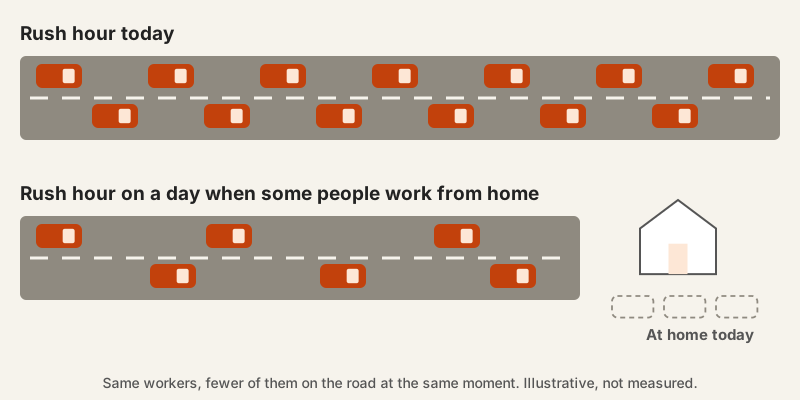
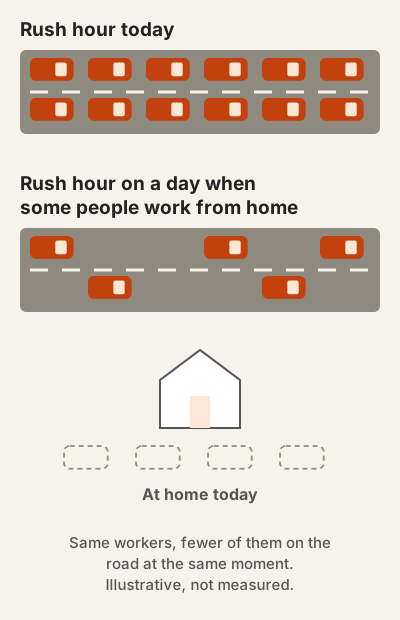
This will not empty the roads. Most jobs in Malta cannot be done from home.[6] The aim is narrower: fewer cars on the road at the same moment. A worker who stays home even one or two days a week takes their car out of the rush hour on those days, and leaves more space for the people who have no choice but to drive. Transport Malta already asks drivers to travel later in the day where they can, to ease the peak.[9] A right to request remote work gives that advice some force.
Benefits
- Shorter queues for everyone. Every car that stays home at rush hour leaves room for buses, deliveries, tradespeople and the workers who must be on site.
- Lower cost of congestion. Traffic already costs Malta about 3.3% of GDP a year.[2] Taking even a small share of cars out of the peak chips away at that bill.
- Cleaner air on busy roads. When traffic fell in spring 2020, nitrogen dioxide at the Msida roadside station fell by up to 54%.[1]
- Time back for workers. An hour not spent in traffic is an hour for family, rest or work.
- An edge for employers. Malta’s own employers’ association says flexibility is “one of the major factors” employees look for when choosing a job.[11] A clear process helps employers offer it without negotiating every case from scratch.
- Fairness. Today the right to ask depends on whether you have a young child or care for someone.[3] Everyone else who sits in the same traffic deserves at least the right to ask.
Cost and feasibility
The public cost is small. This is a change in employment law plus a code of practice, not a new road or a new bus line. Ireland’s review of its own law found the process straightforward for employers and recommended no changes to the Act.[4]
The work would build on the government’s own 2026 consultation on leave and remote working.[7] Ireland’s experience also shows one thing to plan for: fewer than half of Irish employees knew the right existed.[4] Any Maltese law should come with a public information campaign.
Likely objections
- “Employers should decide.” Malta’s employers’ association says flexibility should be “left up to the employer”.[11] Under this proposal it still is: the employer can say no. The only change is that the answer must be fair, written and on time. In Ireland, 94% of formal requests were approved in full or in part.[4]
- “Productivity will fall.” An employer can refuse when the job does not suit remote work. In the Netherlands, an approved arrangement can be withdrawn for important business reasons, such as continuous underperformance.[14]
- “Lockdown is not a fair test.” Agreed. Schools and shops were also closed.[1] That is why the proposal asks Transport Malta to measure peak-hour traffic before and after, rather than promise a number.
- “Only office workers benefit.” They are the ones who can work from home, but everyone who has to drive gains from every car that does not.
Examples elsewhere
- Ireland. Since 7 March 2024, every employee can request remote work, and the Workplace Relations Commission published a code of practice on handling requests.[12] The government’s 2026 review found 94% of formal requests approved in full or in part. Its biggest weakness was low awareness, not refusals.[4]
- United Kingdom. Since 6 April 2024, employees can request flexible working from their first day in a job. They can make two requests a year, employers must reply within two months, and they must consult the employee before saying no.[13]
- Netherlands. Under the Flexible Working Act, in force since 2016, employees with at least six months’ service at an employer with 10 or more staff can ask to change where they work. The employer must answer in writing at least a month before the requested start date. If it does not answer, the request is granted.[14]
Sources
- COVID-19-Related Changes in NO2 and O3 Concentrations and Associated Health Effects in Malta. Frontiers in Sustainable Cities, vol. 3 (S. Fenech, N. J. Aquilina, R. Vella, University of Malta). Published 28 January 2021, accessed 15 November 2026. ↩
- Malta's Traffic To Cost €917 Million By 2030, New Master Plan Warns. Lovin Malta, reporting the National Transport Master Plan 2030. Published 24 November 2025, accessed 15 November 2026. ↩
- Work-Life Balance for Parents and Carers Regulations (S.L. 452.125), regulation 10. Laws of Malta. Published 2 August 2022, accessed 15 November 2026. ↩
- Statutory Review Report: Part 3 of the Work Life Balance and Miscellaneous Provisions Act 2023. Department of Enterprise, Tourism and Employment, Ireland. Published 1 March 2026, accessed 15 November 2026. ↩
- Over 450,000 licensed vehicles on Maltese roads between July and September 2025. Malta Daily, reporting NSO figures. Published 11 November 2025, accessed 15 November 2026. ↩
- Remote working study by Central Bank finds 15.5% of jobs in Malta to be teleworkable. BusinessNow, reporting the Central Bank of Malta Quarterly Review. Published 11 February 2021, accessed 15 November 2026. ↩
- Trade unions demand statutory 'right to disconnect' in Malta's family leave reforms. GVZH Advocates, on Legal 500. Published 27 April 2026, accessed 15 November 2026. ↩
- Labour market information: Malta. EURES, European Commission (Eurostat data). Published 24 February 2025, accessed 15 November 2026. ↩
- TM CEO: Use roads during off-peak hours to help ease traffic congestion. MaltaToday. Published 27 September 2023, accessed 15 November 2026. ↩
- Workers would be given right to request remote working, flexi-time, PL promises. The Malta Independent. Published 1 May 2026, accessed 15 November 2026. ↩
- Job flexibility should be left up to the employer: Malta Employers' director general. BusinessNow. Published 14 May 2026, accessed 15 November 2026. ↩
- Ministers introduce right to request remote working and flexible working arrangements for parents and carers. Department of Enterprise, Trade and Employment, Ireland. Published 7 March 2024, accessed 15 November 2026. ↩
- Hardworking Brits backed by new employment protections. Department for Business and Trade, UK. Published 6 April 2024, accessed 15 November 2026. ↩
- Right to Request Remote Working: International Review. Department of Enterprise, Trade and Employment, Ireland. Published 1 July 2021, accessed 15 November 2026. ↩
Support this idea
Anyone can show support once per browser, with no sign-up. The number counts expressions of support, not verified people.
Showing support needs JavaScript turned on.