Should Malta have paid parking?
Street parking is free almost everywhere in Malta. Charging for it divides opinion, so here is the evidence for and against, and a fair way to find out.
Watch the idea in 1 minutes
The problem
Malta had more than 450,000 licensed vehicles in 2025, and the number keeps growing.[1] Almost everywhere outside Valletta, parking on the street is free.
That has a cost, even if nobody pays it at a meter. As far back as 2016, the government’s own transport master plan warned that unrestricted, free parking, available in every locality, was taking space from pavements and other transport, and that the management of parking for residents was “inadequate”.[5]
People feel this most in the busiest towns. In Sliema, the council has asked for a residents’ parking scheme for years. A 2016 survey for the council found 72% of the 300 residents asked were in favour of reserved residents’ zones.[6] The scheme was allowed in 2009, launched in May 2013 and stopped by the transport ministry soon after.[6]
New buildings add to the squeeze. Developers who cannot fit enough parking can pay instead. In 2024 they paid €16 million to skip 4,387 parking spaces in new developments.[3]
So the question keeps coming up: should drivers pay to park on the street, at least in the busiest places?
The proposal
This article does not argue for one answer. It sets out what paid parking could look like, the strongest case on each side, and a fair way to find out.
What paid parking could mean
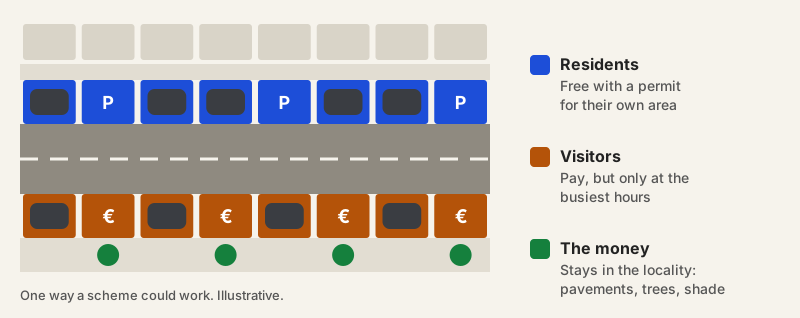
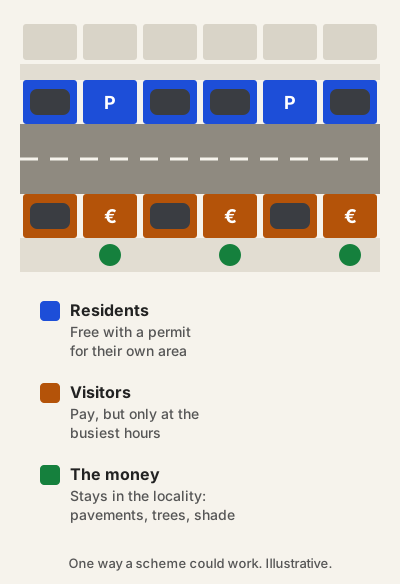
Paid parking does not have to mean paying outside your own home. Most schemes abroad, and the one Malta already runs in Valletta, work like this:
- Residents park free, or almost free, with a permit for their own area.
- Visitors pay to park in the busiest streets, during the busiest hours.
- Prices can follow demand: higher where streets are always full, lower or free where spaces are easy to find.
The case for
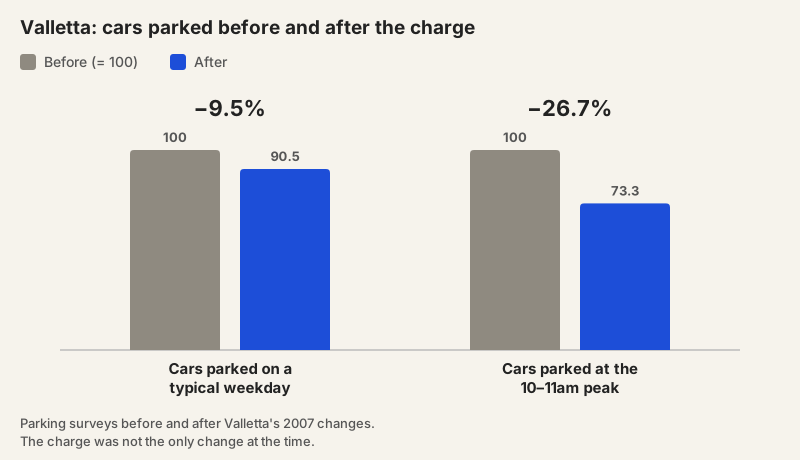
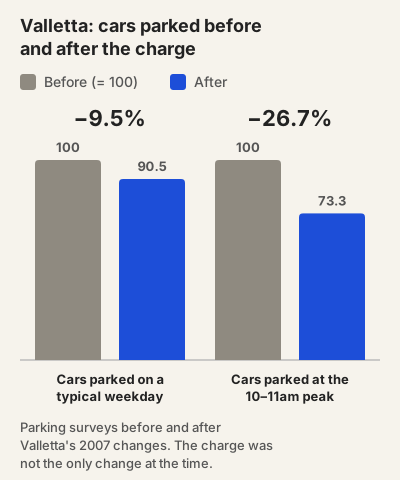
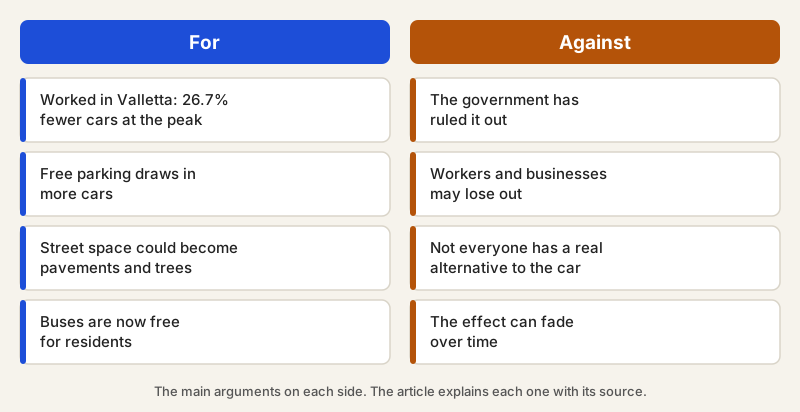
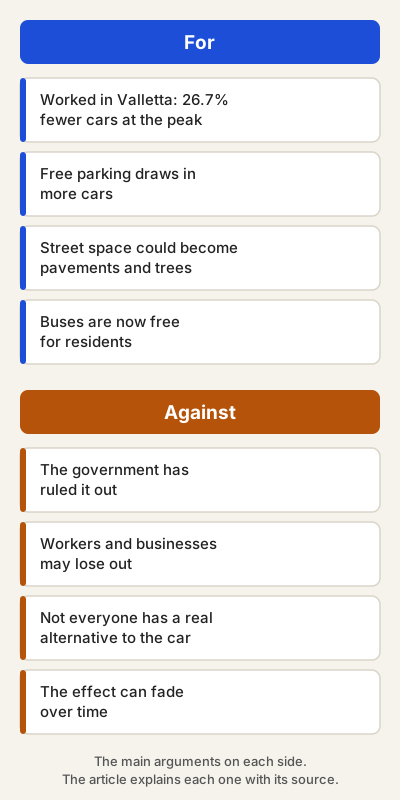
- It has worked in Malta before. In 2007, Valletta replaced its old access licence with a charge based on how long a car stays in the city, with residents exempt.[8] Surveys before and after found 9.5% fewer cars parked in Valletta on a typical weekday, and 26.7% fewer at the 10 to 11am peak. Between 1998 and 2010, about 10% of trips to Valletta shifted from cars to public transport, while car use grew everywhere else. The researchers caution that the charge was not the only change at the time.[2]
- Free parking draws in more cars. After Valletta dropped the charge after 2pm on weekdays and all day at weekends, 3.7% more cars entered the city in the first eight months of 2014 than a year earlier.[9]
- Street space has other uses. eCabs’ chief executive argued that every kerbside space takes public land that could be wider pavements or cycle lanes, and called for fees in Valletta, Sliema and St Julian’s.[10] The director of the University of Malta’s climate change institute has called for “a balance between free parking and parking with a fee”.[11]
- Buses are now free. Since October 2022, residents with a Tallinja card travel free on public transport,[13] so paying to park is no longer the only option for many trips.
The case against
- The government has ruled it out. In October 2025, Transport Minister Chris Bonett said that “under no circumstances” would the government pass on burdens such as parking fees to the public, arguing that better alternatives, not penalties, change behaviour.[4]
- Workers and businesses may suffer. When Sliema pushed for residents’ parking, the General Workers’ Union warned that the hundreds of people who travel to work there, and the town’s businesses, could lose out, and asked for a full parking study first.[7]
- Not everyone has a real alternative. Some trips are hard to make by bus, for example at night, with young children, or right across the island. A charge would fall hardest on people with no other way to get there.
- The effect can fade. In Valletta, the number of cars entering rose again by 3.4% in the charge’s second year, as drivers got used to it.[2]
A fair way to find out
Instead of deciding for the whole country, let one willing council trial it:
- Paid visitor parking on the busiest streets, at the busiest hours only.
- Residents exempt, with free permits.
- Every cent raised spent in the same locality, on pavements, trees, shade or shuttles.
- Traffic, parking and footfall in local shops measured before and after, by someone independent.
- Results published, then a decision on whether to keep it, change it or drop it.
Benefits
If a trial works, it could bring:
- Easier parking for residents, who would no longer compete with all-day parking in their own street.[6]
- Spaces that are easier to find, because they turn over more often. Valletta’s charge encouraged shorter stays,[2] and San Francisco’s pricing cut the time drivers spent searching.[14]
- Better streets, paid for by the scheme itself, in the place that pays for it.
- Evidence instead of argument. A real trial would show what happens in a Maltese town, rather than leaving the question to guesswork on both sides.
Cost and feasibility
Malta already has the tools. Valletta’s system uses number-plate cameras at the city’s entrances to work out how long each car stays, and has done since 2007.[8]
The main costs would be signs, enforcement and running the permits. A trial could be paid for by its own income, and the local council would keep the rest.
How the money is used matters most for fairness. One option, suggested by the Malta Chamber, would credit what drivers pay back into an e-mobility wallet they can spend on shared or sustainable transport.[12]
Examples elsewhere
- Valletta, Malta. The city has charged cars by time spent inside since 2007, with residents exempt. Parked cars at the morning peak fell by about a quarter after it began.[2][8]
- San Francisco. The SFpark pilot raised prices on full blocks and lowered them on empty ones. The average time to find a space fell by 43%, and the average meter price actually went down slightly.[14]
- Barcelona. In the city’s green parking zones, residents pay a token rate to park near home, €0.20 a day in 2018, while non-residents pay the standard visitor rate.[15]
Sources
- Over 450,000 licensed vehicles on Maltese roads between July and September 2025. Malta Daily, reporting NSO figures. Published 11 November 2025, accessed 15 November 2026. ↩
- The effects of road user charges in the context of weak parking policies: the case of Malta. M. Attard and S. Ison, Case Studies on Transport Policy 3 (2015), archived by the University of Malta. Published 11 July 2014, accessed 15 November 2026. ↩
- Building permits issued in 2024 leave Malta with 4,400 parking shortfall. MaltaToday. Published 13 November 2025, accessed 15 November 2026. ↩
- Putting up fuel and licence prices is not the way we should tackle traffic, Transport Minister hits back at PN. Malta Daily. Published 9 October 2025, accessed 15 November 2026. ↩
- Malta's current traffic woes predicted in 2016 master plan. MaltaToday. Published 17 March 2024, accessed 15 November 2026. ↩
- Residents want parking zones, Sliema council to take legal action. MaltaToday. Published 8 June 2016, accessed 15 November 2026. ↩
- GWU warns residential parking could harm Sliema's businesses. MaltaToday. Published 11 June 2016, accessed 15 November 2026. ↩
- New Valletta parking system starts today. The Malta Independent. Published 1 May 2007, accessed 15 November 2026. ↩
- Vehicles swarm into Valletta following free parking scheme. MaltaToday. Published 22 October 2014, accessed 15 November 2026. ↩
- eCabs CEO makes case for on-street parking fees to reduce traffic congestion. MaltaCEOs. Published 19 May 2023, accessed 15 November 2026. ↩
- Parking at a price? Malta's climate change chief suggests fee to park your car publicly. Lovin Malta. Published 26 February 2021, accessed 15 November 2026. ↩
- 'We need to be bold enough to introduce incentives and disincentives': Malta Chamber CEO on traffic. MaltaCEOs. Published 30 June 2026, accessed 15 November 2026. ↩
- Budget 2022: free public transport as from October 2022. MaltaToday. Published 11 October 2021, accessed 15 November 2026. ↩
- SFpark: solving parking and traffic problems with pricing. Urban Land Institute. Published 1 September 2015, accessed 15 November 2026. ↩
- Quarterly ticket for AREA residents, to disappear on the parking meters. B:SM, Barcelona City Council's municipal services company. Published 5 January 2018, accessed 15 November 2026. ↩
Support this idea
Anyone can show support once per browser, with no sign-up. The number counts expressions of support, not verified people.
Showing support needs JavaScript turned on.